Can a circus tent change the way we think? In her bachelor’s thesis, Sigrid Grün examines the Pepe Dome in Munich as a transformative space for a design thinking workshop with teachers on the topic of health. The article demonstrates how unfamiliar spaces can facilitate a shift in perspective, creativity and honest reflection – beyond institutional routines.
Is research an adventure? Definitely! And can it be fun? Yes, very much so! In February 2026, I wrote my bachelor’s thesis on the topic ‘Rethinking teachers’ health: Health-promoting interventions arising from a design thinking process in a circus as a transformative space for thinking – development and testing of a participatory and co-creative design thinking workshop with teachers from different types of school”. The study investigated whether the circus is suitable as a transformative space for thinking. During a reflection phase, the group discussed the impact the venue had on their (creative) work. For reasons of data protection, the reflection section will not be published in full. Only extracts from this part of the thesis are quoted. The theoretical section on the circus as a transformative space for thinking, which contains no personal data whatsoever, is published almost in full.
The Circus as a Transformative Space for Thinking
In the following chapter, the theme of ‘the circus as a transformative space for thought’ will be explored using the example of the Pepe Dome in Munich. This is based, on the one hand, on reports about the circus in Munich’s Ostpark and, on the other hand, on literature concerning theories in the sociology of space and cultural studies that focus on the circus as an unconventional space for thought capable of opening up new perspectives. In addition, literature from the fields of cognitive psychology, social sciences and organisational psychology has also been drawn upon. The circus represents a space that differs from school and administrative work environments on several levels. Whilst schools and classrooms constitute highly institutionalised, regulated and functionally oriented environments, the circus operates on the basis of openness, physicality, aesthetic intensity and temporary social orders. This difference creates atmospheres that can be harnessed for processes of reflection and design. In the context of design thinking and teachers’ wellbeing, the circus serves not only as a physical backdrop, but as an epistemic and symbolic space of possibility in which shifts in perspective, distance and creativity are facilitated.
The Pepe Dome – a contemporary circus as a meeting place in Munich’s Neuperlach district
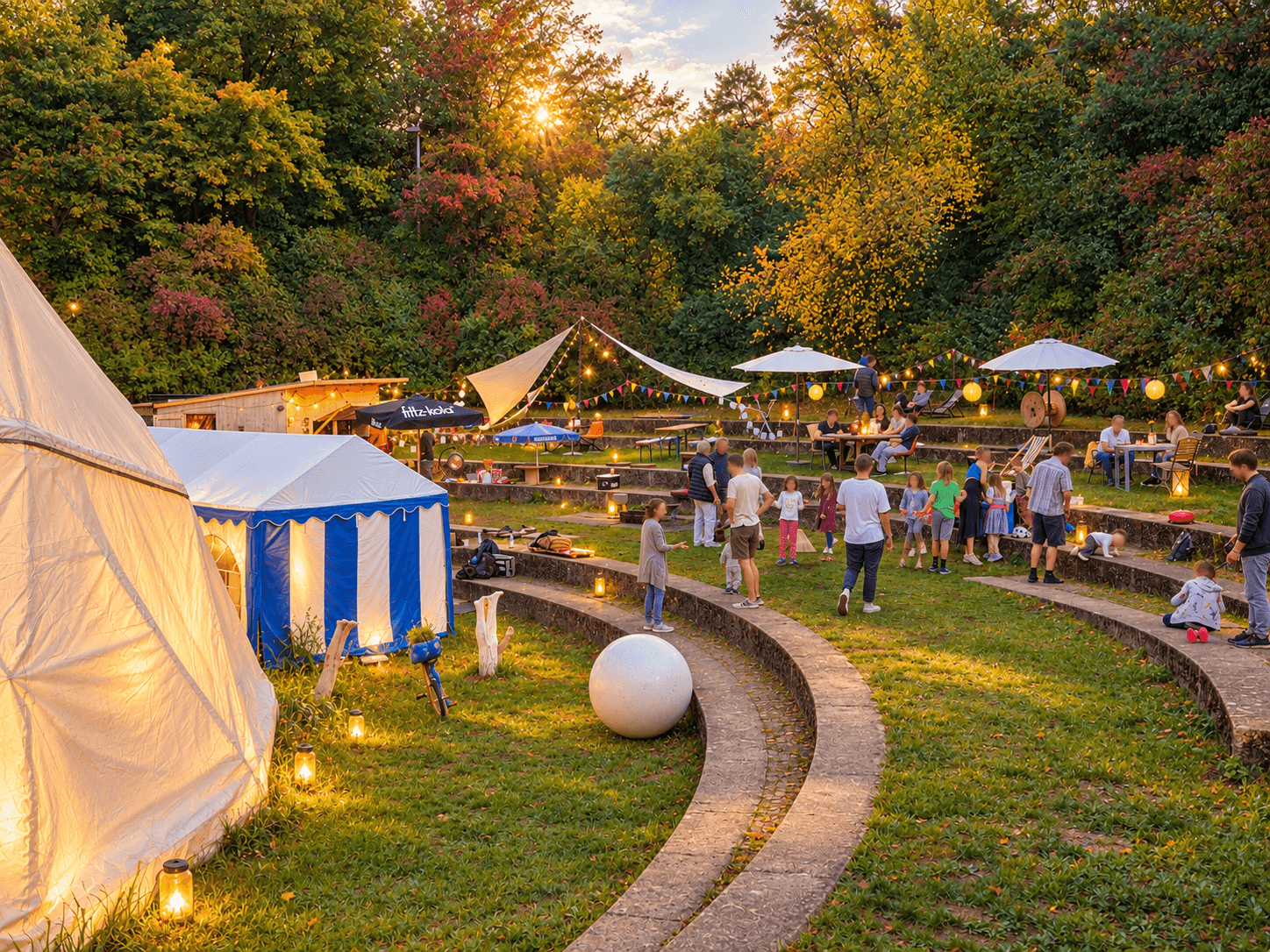
Since mid-August 2025, the Pepe Dome has stood on the site of the Theatron in Munich’s Ostpark. Circus director Michael Heiduk’s aim was not only to create a space for contemporary circus in Bavaria, but also a place for the residents of the Neuperlach district – a ‘permanent cultural centre’ (Beisken-Hengge, 2025). Located in the south-east of Munich, the district is one of Germany’s largest satellite towns, with a population of around 55,000 (Sigg, 2018). Heiduk aims to offer the people in the neighbourhood “a hybrid mix of free movement laboratories, so-called open spaces” – a place where “anyone, regardless of age, background or movement experience, can move freely under supervision” (Zirnstein, 2025). People from the neighbourhood should be able to “drop by and join in without any barriers” (Zirnstein, 2025). Many of the activities on offer are free of charge. The Pepe Dome has become a meeting place. The social psychologist, sociologist and journalist Harald Welzer writes in his book *Das Haus der Gefühle*: ‘It is a social catastrophe that many cities today offer hardly any spaces for encounters that do not require a specific occasion. Particularly for young people, for whom places to ‘hang out’ – meeting points for aimless socialising – are extremely important, city centres offer hardly any suitable spots, let alone covered spaces where people can meet and spend time even in bad weather without spending any money.” (Welzer, 2025)
Spaces for reflection and a change of perspective: theories on the ‘Third Place’ (Oldenburg), ‘Third Space’ (Bhabha), ‘Thirdspace’ (Soja) and ‘espace vécu’ (Lefebvre) The theories on the ‘Third Place’, ‘Third Space’, ‘Thirdspace’ and ‘espace vécu’ offer conceptual approaches to understanding the circus as a space for thought. A concrete application of these spatial-theoretical considerations, applied to the design thinking workshop on teachers’ wellbeing, is developed in the practical section of this thesis. First, however, the theories will be presented in the context of ‘reflection and a change of perspective’. The sociologist and urban planner Ray Oldenburg, together with the behavioural scientist Dennis Brissett, developed the theory of the ‘Third Place’ – an urban sociological approach that can be situated at a socio-spatial, concrete, local level. In their 1982 essay *The Third Place*, the two authors propose the ‘Third Place’ – alongside the home (First Place) and the workplace (Second Place) – as a real, physical location that facilitates informal social interactions. A ‘Third Place’ can, for example, be a café, a bar, a park, a sports ground, a library or a cultural centre. Key characteristics of these places of community-building are their easy accessibility, the opportunity for social mixing, and a relative lack of hierarchy (Oldenburg & Brissett, 1982). The focus is on socialising and communication. Oldenburg later explored and expanded upon the concept in his monograph *The Great Good Place: Cafés, Coffee Shops, Bookshops, Bars, Hair Salons, and Other Hangouts at the Heart of a Community* (2023). In doing so, Oldenburg focuses primarily on the social function of spaces. In the context of this study, the circus is a space in which teachers can set aside their institutional roles. This allows a sense of security to develop, enabling honest discussion of stress, overload and failure. Furthermore, the circus can serve as a venue for informal conversations and thus have a stress-relieving function. Bhabha (1994) describes ‘third spaces’ as hybrid interstitial spaces in which existing categories are broken down and new meanings generated. This fosters shifts in perspective and processes of reflection, as it creates a distance from the everyday context, thereby enabling alternative interpretations of meaning. According to Hansen et al. (2021), the Third Space can also be understood as a space in which members of a group can meet, interact, understand one another and bring together diverse bodies of knowledge in order to develop new insights, ways of thinking and possibilities for action, and to shape new processes. Hansen et al. (2021) also emphasise that such a space can provide important conditions under which existing assumptions can be challenged and mutual learning, as well as the emergence of new ideas through negotiation and co-creation, become possible. The circus can become a ‘third space’ in which familiar identities (e.g. professional or effective teacher) can be challenged and renegotiated. Common narratives, such as the notion that ‘resilience equates to professionalism’, can thus be challenged, creating space for new, hybrid self-images; in this way, for example, competence and vulnerability, professionalism and self-care can be conceived simultaneously, beyond familiar performance-based logics. The American geographer and urban researcher Edvard W. Soja developed the theory of the ‘Third Space’ in 1996. In doing so, he drew on key aspects of Henri Lefebvre’s ‘espace vécu’. Soja’s ‘Thirdspace’ (1996) is an integrative concept of space that brings together three spatial dimensions. Firstspace as material, physical space; Secondspace as imagined, represented space; and Thirdspace as lived space, in which everyday practices, experiences, power relations and forms of resistance unfold. According to this theory of space, the circus can be conceived not merely as a place or a symbol, but as a lived space in which bodies, discourses and practice intertwine. In the circus, Firstspace is the physical setting – such as the big top or the ring; Secondspace comprises notions of the circus, for example as a space for artistic or creative expression; and Thirdspace is the space as it is actually used, experienced and appropriated by the participants. In this way, the topic of teachers’ wellbeing can not only be discussed but also physically experienced. The focus may be on questions such as: Who feels confident enough to speak up? Who takes up space? And who tends to stay on the sidelines? In this way, the appropriation of space in school contexts can also be reflected upon: How much space do I take up in my everyday working life? And how much space do I take up here in the circus? Soja based his concept on an approach developed by Henri Lefebvre (1974), the ‘espace vécu’. Lefebvre distinguishes between three dimensions of space: ‘espace perçu’ (perceived space), ‘espace conçu’ (conceived space) and ‘espace vécu’ (lived space). Perceived space encompasses everyday spatial practices such as walking, sitting or moving around a space. Conceived space describes planned, imagined and institutionally designed spaces. In the context of the circus workshop, this could, for example, be the workshop design. Finally, lived space is the space as it is experienced sensually and emotionally. This spatial dimension relates, for example, to feelings, memories, meaning and atmosphere. Teachers’ wellbeing encompasses not only objective stressors (such as time pressure, noise and an increased workload) or conceptual programmes (e.g. resilience training), but also lived experiences of space, time, the body and relationships in everyday school life. As an unfamiliar setting, the circus allows for a certain distance from school and opens up a space in which subjective experiences of space can be felt and narrated anew. In this way, it becomes a transformative space. In this way, school can be explored as a lived space. For example, by asking the question: How does the school as a workspace feel to me? Physically, in terms of atmosphere and in my experience? Symbolism and Metaphor in the Circus Metaphors open up spaces of possibility and are therefore particularly well-suited to experimental learning settings (Krainz & Paul-Horn, 2021). People are generally particularly receptive to linguistic imagery, as it ‘sticks in the mind and can express feelings and things that are difficult to describe. They can simplify, explain, unsettle or provoke, as they open up new perspectives and ways of seeing things. Metaphors challenge us to recognise connections and provide insights that we ourselves directly construct, the special qualities of which lie beyond the literal meaning. Linguistic images can make us shudder, amuse us or give us pause for thought by appealing to different sensory modalities and conveying emotions.’ (Bachmann, 2016) On a symbolic level, the circus is regarded as a ‘parallel world’ (Konrad & Walkner, 2012) and is rich in metaphors that are applicable both in everyday discourse and in organisational contexts: balancing, juggling, catching, letting go and leaping (Hirsch, 2023) are regarded as culturally established metaphors that can be applied to professional demands (Bachmann, 2016). For teachers, this imagery provides insights into stress and health processes, for example when professional demands are described as juggling or a balancing act. Unlike rational explanations, symbols and metaphors can help people grasp a situation intuitively. The use of metaphors can generally be learnt. Schmitt and Heidenreich (2019) refer to this as ‘metaphoric competence’. Bachmann (2016) explains that metaphors could also help to better understand organisational cultures by jointly searching for linguistic imagery, so that ‘systems and their patterns, situations, people and their actions’ can be better described and viewed differently, ‘as it were from a distance’ (Bachmann, 2016). Such symbolic transfers enable distancing, externalisation and reflection, and can thus reveal psychological and social dynamics that are not readily apparent within an institutional context. Bachmann explains that metaphors enable clients to
“view their own situation from a comforting distance, thereby detaching themselves from the problematic context of normative distinctions such as ‘good versus bad’ or ‘successful versus unsuccessful’, and so on. ‘One’s horizons broaden; one observes, as it were, another person or organisation and can experiment, before re-establishing connections to one’s own specific concerns.’ (Bachmann, 2016)
Furthermore, the circus embodies a narrative of failure and repeated attempts (Hirsch, 2023), whereas in the school context the focus tends to be on avoiding mistakes. In the circus, however, mistakes made during the learning process are not penalised but are regarded as part of the learning and development process. This logic is also central to design thinking. Symbolic levels thus function as bridges between physical experiences, organisational requirements and health discourses.
Unfamiliar spaces vs. institutionalised spaces: impact on creativity and distancing
In addition to the concepts from cultural studies and the sociology of space, which construct the circus as an unfamiliar space for thought, neuroscientific literature can also be drawn upon to underpin the research approach. Schomaker and Meeter (2015) investigated the effect of unfamiliar, novel stimuli on perception and motivation. The Dutch neuropsychologists argue that unfamiliar spaces (‘spatial novelty’) have various stimulating effects, such as promoting the release of dopamine and thus influencing motivation and reward processing. Furthermore, new environments are said to elicit exploratory behaviour and have positive effects on learning and memory. These are all highly suitable conditions for conducting a design thinking workshop. Research into creativity shows that spatial and atmospheric environments influence creative processes (Kristensen, 2004). Unfamiliar spaces generate disruptions and distractions that can break routines and trigger new forms of perception and thinking. Institutionalised spaces such as schools, administrative areas or seminar rooms, on the other hand, are often associated with role expectations, hierarchies and clearly structured interactions, and can restrict creative processes if they appear too prescriptive. In the context of teachers’ well-being, spatial distancing is relevant, as reflection on stressors and resources can take place more easily and openly outside the everyday school structure. The circus offers a spatial contrast for this purpose that is coded as neither school-like nor private (Oldenburg & Brissett, 1982). The difference between an institutionalised and an unfamiliar environment can thus act as a catalyst for distancing, a change of perspective and experimental problem-solving. These are important prerequisites both for the design thinking process and for health-related self-reflection. Reflection (excerpts) The circus tent was perceived as ‘inspiring’ and ‘very cosy’. It rained during the workshop, which was described as a ‘pleasant and soothing background sound’. The unusual atmosphere was also noted in relation to the lighting. The size of the room was said to have had a special effect as well. One participant remarked: “The height, the expanse. It’s not like being in a cramped room. There are no windows, and yet it’s bright and open. And the natural surroundings are brilliant too!” A female participant added: “Yes, it’s something completely different.” […] The room was also discussed in relation to the development of ideas. The members of the ‘XXX’ development team explained that, in a school context, they would very likely not have come up with such an idea and would probably have stuck to ‘the usual paths’. […] The effect that an unfamiliar space could ‘change the way people think’ was found to be quite astonishing, and there was a discussion about how this could be put to good use in schools. In this regard, the teachers noted that there were hardly any school trips any more, as these would involve a great deal of effort and risk.
One participant remarked
“I thought it was brilliant that, with the help of the images right in front of me here, I could work things out for myself rather than having it told to me by someone else. If someone else had told me that I have a problem because I see myself as a lone warrior, I would probably have resisted such a claim. But when you come to that realisation yourself, it’s a different matter altogether.” (Notes by S.G.)
Another teacher suggested that the situation might be similar for the pupils. And a third teacher added: “Perhaps the concept of school, as it stands, isn’t exactly ideal for learning.” The group then discussed working with circus metaphors. This approach was also considered suitable for use in the classroom. […] Conclusion This study examined the extent to which a creative approach can contribute to health promotion in the teaching profession. The workshop consisted of two parts: a theoretical part, in which various models were presented in advance to raise awareness of the topic of teachers’ health. In the second part, which was practice-oriented, approaches from the sociology of space were explored and a design thinking process was carried out within a circus setting, viewed as a potentially transformative space for reflection. The results of the workshop illustrate that design thinking, combined with theoretically acquired knowledge and a change of setting, can help not only to reflect analytically on the complex challenges of teachers’ health, but also to address them in a solution-oriented manner together with the stakeholders concerned. A key aspect of the approach was the participation of teachers. During the workshop process, they were not merely addressed as the target group for health-related measures, but were involved in the development of potential interventions as experts in their day-to-day professional lives. This form of co-creativity made it possible to incorporate individual experiences, perceptions and interpretations into the generation of ideas. In the process, latent needs also came to light which often remain unspoken and unconscious in everyday school life, such as the desire for exchange, community and a sense of agency. The joint development of ideas and prototypes also served as a catalyst for processes of self-reflection and mutual support within the group. In this context, it became apparent that the workshop not only contributed to the development of concrete solutions but also facilitated experiences of community and exchange. Such experiences can make an important contribution to strengthening teachers’ self-efficacy, as they foster the sense that they can collectively influence stressful working conditions. The transformative venue for the workshop played a particular role in this. The circus, as an unconventional space for reflection, provided a physical and symbolic distance from everyday school life. This distance created scope for new perspectives and creative thought processes. Through the physical and sensory environment, participants were able to temporarily step away from entrenched routines and develop alternative perspectives on work-related stress. The space thus functioned not merely as a backdrop, but as an active component of the creative process.
References
Bachmann, T. (2016). Cognitive psychological foundations for the use of linguistic imagery in coaching and counselling. Organisational Consultancy, Supervision, Coaching, 23, 269–283. https://doi.org/10.1007/s11613-016-0463-3. Beisken-Hengge, S. (2025, 17 October). A home for modern circus: ‘Pepe Dome’ in Ostpark to be permanently established. tz. Available online at: https://www.tz.de/muenchen/stadt/hallo-muenchen/muenchen-perlach-ostpark-pepe-dome-kulturhaus-projekt-heimat-kuenstler-zirkus-artisten-93987038.html. Bhabha, H.K. (1994). The Location of Culture. Routledge. Hansen, P., Fourie, I., Meyer, A. (2021). Third Space, Information Sharing, and Participatory Design. https://doi.org/10.2200/S01096ED1V01Y202105ICR074. Hirsch, Helen (2023). Not my Circus, not my Monkeys. The circus motif in contemporary art. Hirmer. Konrad, V., Walkner, M. (2012). The Circus as a Parallel World. Kunsthalle Wien. Verlag für moderne Kunst. Krainz, E.E., Paul-Horn, I. (2021). Metaphor as Intervention. The Moving Power of Linguistic Images. In: Paul-Horn, I., Rabl, T. (eds.), Research that Intervenes. Contributions to the Theory and Methodology of Counselling. 275–302. Springer. Kristensen, T. (2004). The Physical Context of Creativity. Creativity and Innovation Management, 13(2), 89–96. Available online at: https://www.researchgate.net/publication/227546783_The_Physical_Context_of_Creativity. Lefebvre, H. (1974). The Production of Space, Blackwell. Oldenburg, R., Brissett, D. (1982). The third place. Qualitative Sociology 5, 265–284. https://doi.org/10.1007/BF00986754. Oldenburg, R. (2023). The Great Good Place: Cafés, Coffee Shops, Bookshops, Bars, Hair Salons, and Other Hangouts at the Heart of a Community (2nd edition), Berkshire Publishing Group LLC. Schmitt, R., Heidenreich, T. (2019). Metaphors in Psychotherapy and Counselling. A Metaphor-Reflective Perspective. Beltz. Schomaker, J., Meeter, M. (2015). Short- and long-lasting consequences of novelty, deviance and surprise on the brain and cognition. Neuroscience and Biobehavioural Reviews, 55, 268–279. https://doi.org/10.1016/j.neubiorev.2015.05.002. Sigg, C. (2018). Study on Munich’s neighbourhoods: Neuperlach is lovely! Available online at: https://www.arc.ed.tum.de/fileadmin/w00cgv/eud/pdf/Studie_ueber_Muenchner_Stadtviertel__Neuperlach_ist_schoen____Abendzeitung_Muenchen.pdf. Soja, E. (1996). Thirdspace: Journeys to Los Angeles and Other Real and Imagined Places, Blackwell. Welzer, H. (2025). The House of Emotions. Fischer. Zirnstein, M. (2025, 5 June). A dedicated tent for contemporary circus. Süddeutsche Zeitung. Available online at: https://www.sueddeutsche.de/muenchen/zirkus-zelt-neuperlach-pepe-arts-muenchen-kulturausschuss-li.3262786.
Stay informed
Get the latest news, backstage stories and event updates.